


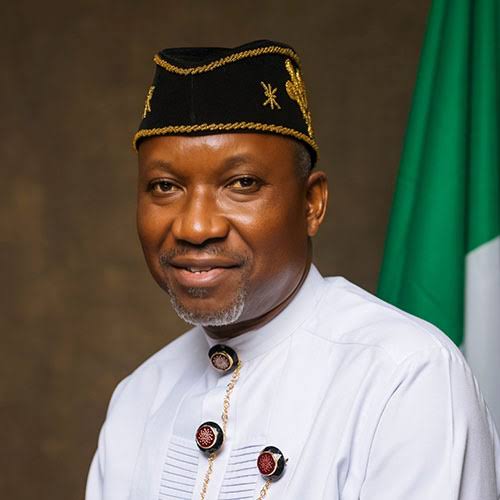
The attacks have started again. The accusations too. The target is Rt. Hon. Ekperikpe Ekpo, Minister of State Petroleum Resources (Gas).
Some commentators have gone as far as calling him demeaning names. The Minister’s offence? The rising cost of cooking gas.
Fair enough. Nigerians are hurting. The price of Liquefied Petroleum Gas (LPG), commonly known as cooking gas, has risen considerably and everyone is affected. Nobody should pretend otherwise.
But before we crucify Ekperikpe Ekpo, we should ask a simple question. Is the Minister responsible for the US/Israel and Iran wars, or the attendant economic disruptions currently shaking the global energy market? The answer is no.
How is a conflict taking place thousands of miles from Nigeria affecting our livelihoods so severely? One may ask.
Nigeria is part of the global energy industry and does not operate in isolation.
Days ago, precisely June 11, Iran announced that the Strait of Hormuz has been completely closed to all oil tankers and commercial ships in response to recent US strikes on the country, and stated that any vessel attempting to pass would be shot at.
For those who may not know, the Strait is one of the world’s most important maritime routes. As a matter of fact, it is the only route to the open sea for oil producers in the Gulf.
According to some estimates, nearly 20 % of all crude oil and natural gas bound for global markets passed through the strait in 2024.
Complete closure of that route has therefore created global uncertainty, with no clarity on how high energy prices will go in the coming months.
When wars break out in major oil and gas-producing regions, shipping routes become threatened, supply chains tighten, freight costs increase and energy commodities become more expensive.
This, in summary, explains the hike in LPG prices. We are simply feeling the adverse impact of tensions in the Middle East.
So, to lampoon Obongemem Ekperikpe Ekpo over the price of cooking gas across Nigeria, is therefore misunderstanding how the gas market works or deliberate convenient scapegoating.
But is the Minister concerned about the cost of LPG? Certainly yes.
Weeks ago, he convened critical engagements with the Nigerian Midstream and Downstream Petroleum Regulatory Authority (NMDPRA) and other key stakeholders to consider some interventions in the rising cost and availability of LPG across the country.
Steps are being taken to minimise the scourge of the crisis on Nigerians and sooner than later, we will feel the impact.
At every function, the Minister has repeatedly emphasised the need for stronger domestic gas utilisation, increased local participation and improved distribution networks across the country.
Under his leadership, the federal government has continued to prioritise domestic availability of LPG. He has ensured, through regulatory authorities, that locally produced gas serves Nigerian consumers first, before any consideration of exports.
If that domestication policy wasn’t in place, we would have probably paid far more for LPG than we are currently paying.
The reality is that gas sector reforms are not magic. Pipelines are not built overnight. Processing facilities do not emerge in six months. Storage terminals take years to develop. Gas infrastructure requires billions of dollars in investment, extensive engineering and long-term planning. Results come gradually.
That is why serious leaders focus on building solid foundations for the future. That is exactly what Rt. Hon. Ekperikpe Ekpo is doing under the Renewed Hope Agenda.
The critics also talk about the Minister’s foreign engagementsm. A brief enlightenment on this is perhaps important.
From whatever standpoint, gas development requires investments and investments do not fall from the sky.
Investments must be negotiated, relationships built and confidence earned for some policies to come through. Primarily, that is why Presidents, Governors, Ministers travel. Nobody signs billion-dollar energy deals sitting permanently behind a desk in Abuja.
Those official engagements are not sightseeing excursions, but serious economic missions.
For instance, at the just concluded Global Energy Show in Canada, Rt. Hon. Ekperikpe Ekpo held bilateral discussions with Alberta’s Minister of Energy and Minerals, Brian Jean.
The meeting ended with an agreement between Nigeria and the Canadian Province of Alberta to establish a joint technical working group, develop an MoU covering key areas of cooperation, facilitate technical exchanges on carbon capture and emissions reduction, promote academic and capacity-building partnerships, and explore broader collaboration in petrochemicals and energy industrialisation.
Recently too, the Minister met with the president of the People’s Democratic Republic of Algeria, Mr. Abdul Majeed Tabun, at the State House, Algiers, where talks centered around advancing the Trans-Saharan Gas Pipeline (TSGP) project.
That trip dovetailed into the 5th Ministerial Meeting of the Steering Committee for the Trans Sahara Gas Pipeline Project (TSGP), where Nigeria, Niger Republic and Algeria, signed and approved the final report of the feasibility study, for the project to move to the next stage.
Don’t forget that Obongemem Ekperikpe Ekpo is President of the 2026 Ministerial Meeting of the Gas Exporting Countries Forum (GECF) and Chairman, Committee of Ministers, West African Gas Pipeline (WAGP) Project. The task of meeting up with all of these responsibilities explains some of his official trips.
You get the point now?
We haven’t gotten there yet, but the progress recorded under Rt. Hon. Ekperikpe Ekpo’s watch commendable.
Today, work is also progressing at the OB3 Pipeline and Ajaokuta-Kaduna-Kano (AKK) Gas Pipeline, two of Nigeria’s most strategic infrastructure projects aimed at delivering gas to industries, power plants and businesses in Nigeria.
People are free to criticise. That is democracy. They are free to demand more from their leaders. That too, is democracy. But they should do so constructively, not from political frustration, personal dislike or convenient scapegoating.
Rt. Hon. Ekperikpe Ekpo is working hard to attract investments, deepen domestic gas utilisation and ensure that Nigeria’s enormous gas wealth benefits ordinary citizens.
That journey is not finished. but it is steadily progressing.