


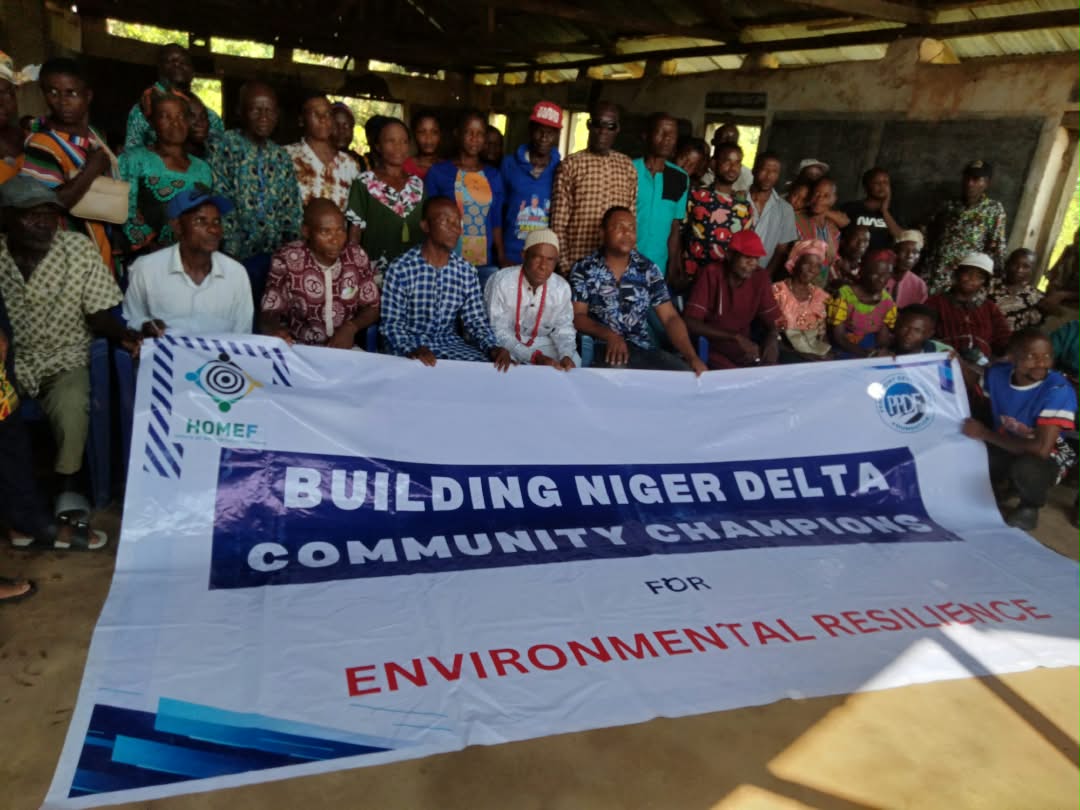
Residents of Ntan Mbat, a fishing community in Ibiono Ibom Local Government Area of Akwa Ibom State, are preparing to petition petroleum regulators and the National Assembly over recurring oil pollution they say is threatening their livelihoods and fishing grounds.
The decision followed a community training on environmental rights, grassroots organising and advocacy held on Monday at Ntan Mbat Community Hall. The programme was organised by Peace Point Development Foundation (PPDF), in partnership with the Health of Mother Earth Foundation (HOMEF).
The residents said oil sheen regularly appeared on their fishing waters, particularly during the rainy season, reducing fish catches and affecting people across the fishing value chain, including fishermen, fish dryers and traders.
They want the Nigerian Upstream Petroleum Regulatory Commission (NUPRC), the National Oil Spill Detection and Response Agency (NOSDRA) and the National Assembly to investigate the recurring pollution and establish its source.
At the centre of their concerns are three oil wells reportedly drilled and capped in the 1950s at Esuk Ntan Mbat, an area within Ntan Mbat that is not recognised as a separate certified village.
Although residents suspect the wells may be connected to the recurring appearance of oil on their waterways, they said they could not on their own ascertain the precise source of the pollution.
The affected waterways also connect to the Calabar-Itu River, raising concerns about the possible spread of contamination beyond the immediate community.
Decades of complaints
Ntan Mbat comprises four villages: Edem Ntan Mbat, Obot Ukim Ntan Mbat, Obot Enang Ntan Mbat and Usuk Ntan Mbat.
Friday Akpan, the village council chairman of Ntan Mbat, said residents had repeatedly appealed to government officials and political representatives over the problem without receiving the intervention they sought.
“Every rainy season, oil will spill all over the community. We, as a community, will call on the government to come to our plight, especially at the state level through our representatives in the past, but nothing is forthcoming,” he said.
Mr Akpan said the training had equipped residents with knowledge of the institutions responsible for addressing environmental pollution and the channels through which they could demand action.

“We are delighted with the training today. It has opened our eyes to the regulators and duty bearers we will now approach, NOSDRA, NUPRC and the National Assembly. We will petition them to come and look into the matter,” he said.
The village head of Obot Ukim, Chief Enefiok Bassey, also pledged to mobilise the heads of the other three villages to jointly petition the relevant authorities.
He said the recurring oil sheen had seriously affected residents who depend on fishing.
“When we see the oil sheen on the water, which usually happens during the rainy season, we don’t see fish to catch at all,” he said.
The consequences extend beyond fishermen. Women who smoke and process fish, as well as traders who depend on regular supplies, also suffer when catches decline.
AKSU secures landmark partnership with Institute of Oceanology at Chinese Academy of Sciences
For Mercy Okon ” The crude oil in our waters does not allow us to support our family again. During the rainy season we abandon fishing because the oil pursues fishes away from our water. Even with the fish that should be in our river, we now go elsewhere to buy fish and it becomes more expensive considering the transport cost. The government should come and see this problem by themselves”.
Building community power
The training focused on helping residents understand environmental justice, document pollution incidents and organise collective demands for government intervention.
In his presentation, Umo Isuaikoh, coordinator of PPDF, discussed the Nigeria Socio-Ecological Alternatives Charter (NSAC) and the Niger Delta Alternatives Convergence (NDAC).
The frameworks promote development that protects people, land and water, with emphasis on environmental restoration, community participation in decisions affecting natural resources and alternatives to dependence on oil extraction.
They also advocate the protection of rivers, creeks and mangroves, as well as the principle that those responsible for environmental damage should bear the cost of remediation.
The presentation pointed out the need for fishing communities to have a voice in decisions affecting their waterways and for compensation to address actual livelihood losses rather than serve as a substitute for environmental restoration.
An environmentalist, Peace Udoh, who spoke on grassroots organising and advocacy for environmental justice, called on residents to document changes in their environment and fishing activities.
She encouraged participants to record fish catches, species, sizes, fishing locations, unusual watercolor, dead fish and suspected pollution incidents.
She said individual observations could become valuable community evidence when systematically documented and independently verified.
“Your experience is data,” she told participants, explaining that the knowledge of people who depend on rivers and creeks daily could help establish patterns of environmental degradation.
She said fishers possess valuable knowledge of traditional fishing grounds, breeding areas, seasonal changes and pollution hotspots, which could support investigations by researchers and regulatory authorities.
Ms Udoh called on residents to move beyond individual complaints by organising across communities, submitting petitions, attending public hearings, engaging journalists and monitoring government responses.
She said environmental resistance did not necessarily mean confrontation, but could involve peaceful and sustained efforts to ensure that environmental problems were not ignored or normalised.
Need for Improved storytelling
The training also examined how the communities can effectively communicate their environmental challenges especially through storytelling.
She encouraged community members to explore practical environmental protection measures, including mangrove restoration, shoreline clean-ups, improved fish-smoking ovens, responsible fishing practices and cooperative societies.
Ms Udoh said these practices can be institutionalised through storytelling and folktales.
She also encouraged residents to use local radio, community meetings, WhatsApp voice notes and partnerships with media organisations to communicate their experiences and demands.
The organisers said the training was intended to strengthen the ability of fishing communities to defend their environmental rights through evidence, collective action and engagement with relevant authorities.
The training ended with the inauguration of community members into the Fishnet alliance, a network of fisher folk across Africa promoting sustainable fishing practices in line with ecosystem limits.