


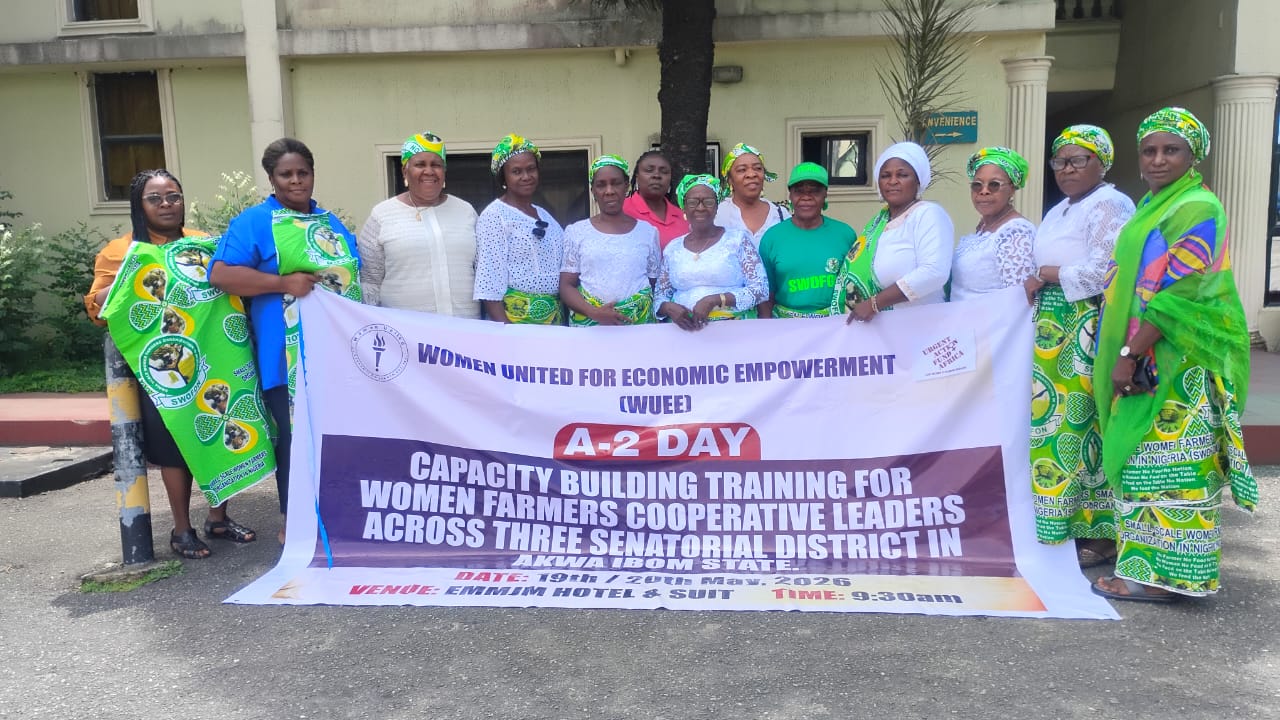
The call was made by Professor Edna Akpan, of the University of Uyo, during the training organized at EMMJM Hotels, Uyo, by a non governmental organization -Women United for Economic Empowerment, WUEE, on the project titled, “persistent and systemic marginalization of women farmers in Akwa Ibom State from agricultural services, productive resources, financing systems, and decision-making structures that directly influence their productivity and livelihoods”, sponsored by Urgent Action Fund(UAF) Africa.
Speaking at the training which had 45 women farmers’ group leaders and other stakeholders drawn from three communities each from Ini, Etinan, and Okobo local government areas of Akwa Ibom State, Akpan noted that more than 80 to 85 percent of women constitute the nation’s agricultural sector and contribute significantly to farming processing and production.
Presenting a paper on “Gender Inclusion In Akwa Ibom State’s Agricultural Sector”, and “Gender issues in Akwa Ibom State Agricultural Sector, emerging opportunities for female farmers and recommendations for increased participation in the agri-sevtor”, she noted that the National Gender Policy in Agriculture supports equal access to agricultural resources and services, while Nigeria’s Agricultural Promotion Policy, encourages women and youth participation in agribusiness, Sustainable Development Goals, especially, SDG 5 and SDG 2, promote gender equality and zero hunger.
Akpan mentioned the gaps in gender inclusion as, limited land ownership and inheritance rights for women, insufficient representation of women in agricultural decision -making processes, unequal access to mechanization, improved inputs and modern technologies, and inadequate sensitive data for planning and policy implementation, while challenges faced by women farmers include poor access to credit facilities and agricultural insurance, cultural and social barriers that restrict women’s economic participation, high cost of farm inputs, transportation and storage facilities, climate change impacts and agricultural insecurity affecting agricultural productivity, as well as limited extension contact and weak rural infrastructure.
She listed the effects of gender inequality in agriculture to include reduced agricultural productivity and efficiency, increased rural poverty among women-led households, reduced household income and food security, among others, and also recommended increased funding by government for women-focused agricultural programmes and improved rural infrastructure, provision of affordable credit facilities and flexible loan conditions by financial institutions, amongst others.
Presentations were also made on Appraisal of the Agriculture and Food Security committee in Akwa Ibom State, and “Gender disaggregation tracking process in Akwa Ibom State agricultural sector”, by a one time commissioner for Agriculture in the State, Professor Trenchard Ibia, who said mainstreaming gender related issues, compiling of farmer digital registry, strengthening and ensuring women access to resources, improving data management capacity by training extension officers and programme managers on data collection, analysis, and reporting, as well as promoting multi- stakeholder collaboration through data generation, sharing and implementation by the respective stakeholders such as government agencies, NGOs, financial institutions and farmer groups, etc, will combat gender disaggregation tracking challenges.
Also read:
SEEPCO, VCDF empower women in Eastern Obolo through
In her opening remarks, the Executive Director, WUEE, Mrs. Iniobong Frank, identified lack of information communication as one of the factors that contributes to challenges faced by women farmers in communities, explaining that in most cases, lack of knowledge about existence of agric extension workers by rural women farmers resulted in their refusal to listen to those officers and provide them their data when they visit communities, calling on local government councils to organize town hall meetings to educate them on the existence of such officers.
Frank who was represented by Rosemary Jumbo, also frowning at the poor attitudes of women farmers in the grassroots who in most cases refused to listen to extension workers and provide their data when required, urging them to change their attitude to aid their inclusion in the State’s agricultural sector, and expressing hope that they will impart others with the knowledge gained during the training.
Giving an overview of the project, the programme officer, WUEE, Mr Joshua Nya, said the project seeks to address the persistent and systemic marginalization of women farmers in Akwa Ibom State from agricultural services, productive resources, financing systems, and decision -making structures that directly influence other productivity and livelihoods.
Nya said the objective of the project was to ensure that agricultural reforms within Akwa Ibom were implemented through a deliberate gender- responsive lens, while the project goal is to promote structured inclusion of women farmers in agricultural planning, service delivery, financing access, and decision -making platforms.
Goodwill messages were presented by the director of Agriculture, Etinan, Mr Emmanuel Isong, his counterpart in Okobo, Pastor Henry Etim, representatives of Bank of Agriculture(BOA), and Small Women Farmers Of Nigeria (SWOFON), Akwa Ibom State chapter, who all lauded WUEE for building capacity of women farmers across the three local government areas.
At the capacity training, participants from Ini Local Government Area, said they were faced with the challenge of poor access roads to bring their farm produce to city markets, which usually resulted in low profits as they become off takers of their produce; lack of farm inputs; lack of means of irrigation for watering of their produce; loss of produce to thieves; limited information and non access to information on government grants and farm inputs; increase in registration fee of cooperative societies from N20,000 to N50,000, as well as open grazing leading to damages of farmlands and produce by cattle.
Participants complained that after spending their time and resources to develop their farmlands, they are usually destroyed by cattle owned by politicians, thereby leading to poor or no yield, urging government to revisit the anti-grazing law raised by the last administration in the state, and ensure its successful enactment to safe farmers from their predicaments.
Recall that WUEE had organized the community sensitization meeting with community farmers, especially women, in three select communities in Ini, Etinan and Okobo local government areas, during which they decried lack of access to financing, mechanization, improved seedlings, and extension support for farming, as their challenges.