


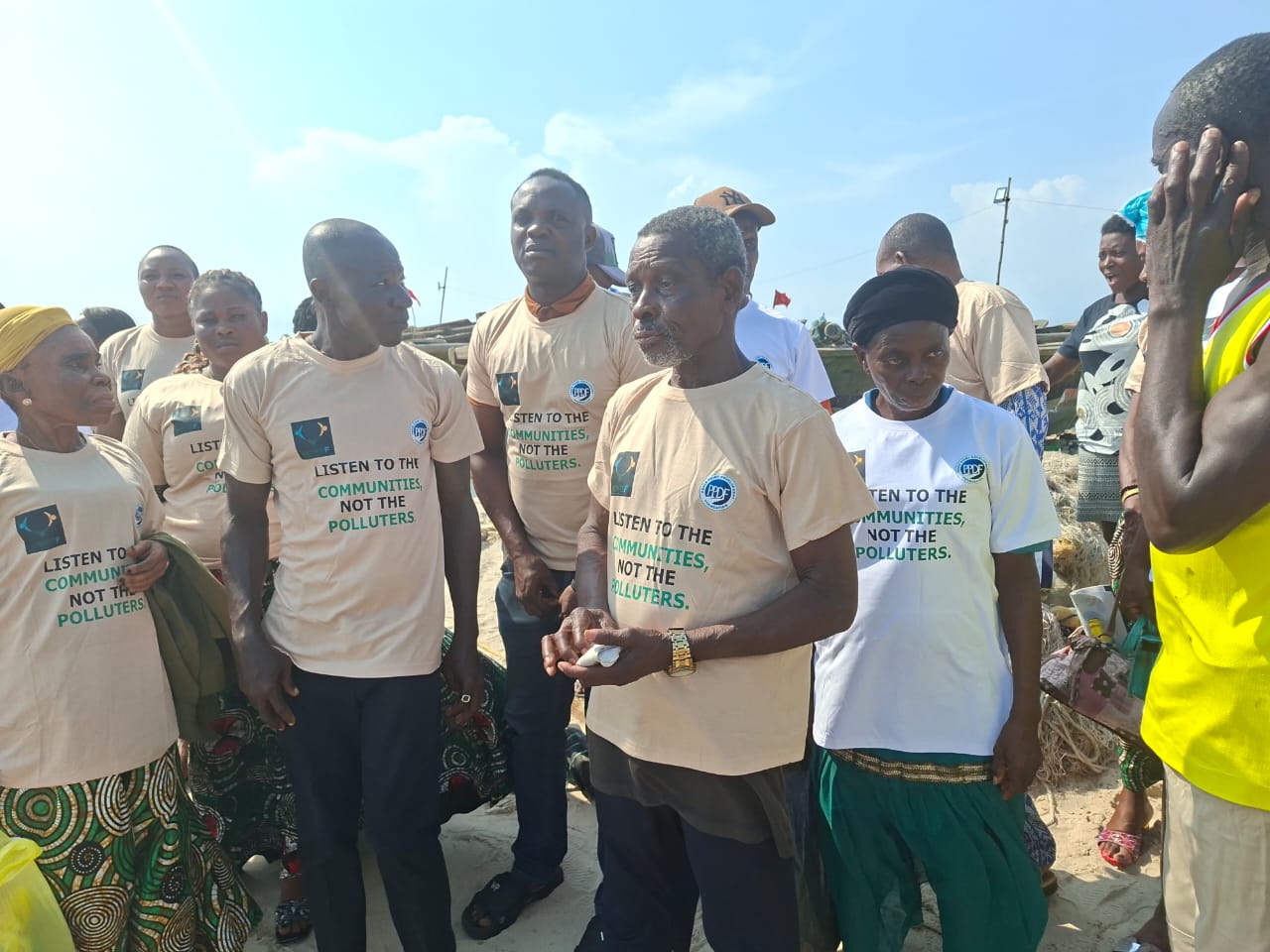
Fishers from coastal communities in Akwa Ibom and Cross River states have raised alarm over worsening oil pollution, sea piracy, and rising operational costs, saying the challenges are crippling livelihoods and threatening fish stocks in the Niger Delta.
The concerns were voiced on 27 March during an exchange visit involving fishers from Ibeno in Akwa Ibom State and Eserebom community in Calabar South Local Government Area of Cross River State. The visit included tours of beach landing sites and fish drying facilities in Ibeno.
The exchange visit forms part of a “Community Rights Defenders” project implemented by Peace Point Development Foundation (PPDF) in collaboration with the Health of Mother Earth Foundation, focusing on environmental justice and sustainable livelihoods in coastal communities.
Speaking during the engagement, a veteran fisher, Omotoye Julius, who migrated from Ondo State and has fished in Ibeno since 1960, said decades of experience have not shielded fishers from mounting difficulties.
“We are the ones who have taught fishers from Ibeno and Eastern Obolo how to fish,” Mr Julius said. “We have learnt how to navigate strong waves using big boats and paddles. Sometimes, we even listen to the ‘voice’ of the fish to know where they are.”
Despite such traditional knowledge, he said oil exploration activities have severely disrupted fishing patterns and access to productive waters.
“There are areas with plenty of fish, but security operatives warn us not to go near because of oil installations. The Navy does not allow us to fish close to these facilities,” he said.
He added that oil spills frequently damage fishing gear and marine life.
“The oil spoils our nets and kills the fish. Sometimes, we stay up to three months without catching anything. The smell alone is enough to drive fish away,” he said. “It also flows into the mangroves and destroys fish eggs. During these periods, we fall into debt.”
Mr Julius criticised the response to oil spills, noting that clean-up efforts are often inadequate.
“We rarely see proper clean-up. Most times, companies and authorities leave it to natural tides to wash the oil ashore,” he said.
He also linked gas flaring to changes in water temperature, forcing fish to migrate farther offshore.
“We now spend more on fuel to reach deeper waters where flare effects are less,” he said.
Fishers also lamented the withdrawal of government support.
“In the past, government provided boat engines and nets. We no longer see such assistance. Authorities should enforce environmental laws to deter pollution,” Mr Julius added.
Another fisher, Wole Ayeye, highlighted insecurity on the waterways as a major concern.
“Sea pirates seize our engines and sometimes kidnap fishers for ransom,” Mr Ayeye said. “They give you a number to call and demand between N2 million and N5 million.”
He said the threat of piracy has restricted access to fishing grounds.
“We cannot explore freely because of fear. It reduces our catch,” he said.
Mr Ayeye disclosed that fishers now pay for security escorts during fishing expeditions, although coverage is often limited in deep waters.
He also pointed to the high cost of operations.
“For every trip, we buy about 140 litres of fuel at N1,500 per litre. That is what we spend daily, yet we still pay taxes to the community,” he said.
For the fishers in Cross River, the Village Head of Eserebom, Obonganwan Elizabeth Akami-eyo who is also a fisher, identified environmental degradation as a key driver of declining fish stocks.
“The destruction of mangroves for firewood and timber is exposing fish breeding grounds to damage,” she said.
“Irresponsible disposal of oil from dismantled ships along the shoreline also affects fishing.”
She said the challenges faced by fishers in Cross River and Akwa Ibom were similar hence there is need for both communities to come together to tackle the challenges they faced.
The Coordinator of Peace Point Development Foundation, Umo Isua-Ikoh, who facilitated the exchange visit, said the initiative aimed to strengthen collaboration among coastal communities.
He urged participants to apply lessons from a recent stakeholders’ dialogue on building community rights defenders in the Niger Delta.
Mr Isua-Ikoh said the inclusion of the communities in the FishNet Alliance—a regional network advocating against harmful fishing and pollution—would provide greater support.
“Through this alliance, fishers will gain more knowledge on protecting their livelihoods and demanding accountability,” he said.
Communities at the end of the engagement agreed to engage National Oil Spill Detection and Response Agency, Nigerian Upstream Petroleum Regulatory Commission and the Ministry of Environment of both States on how they can intervene to stop oil and gas pollution and also address the concerns of disappearing mangroves.