


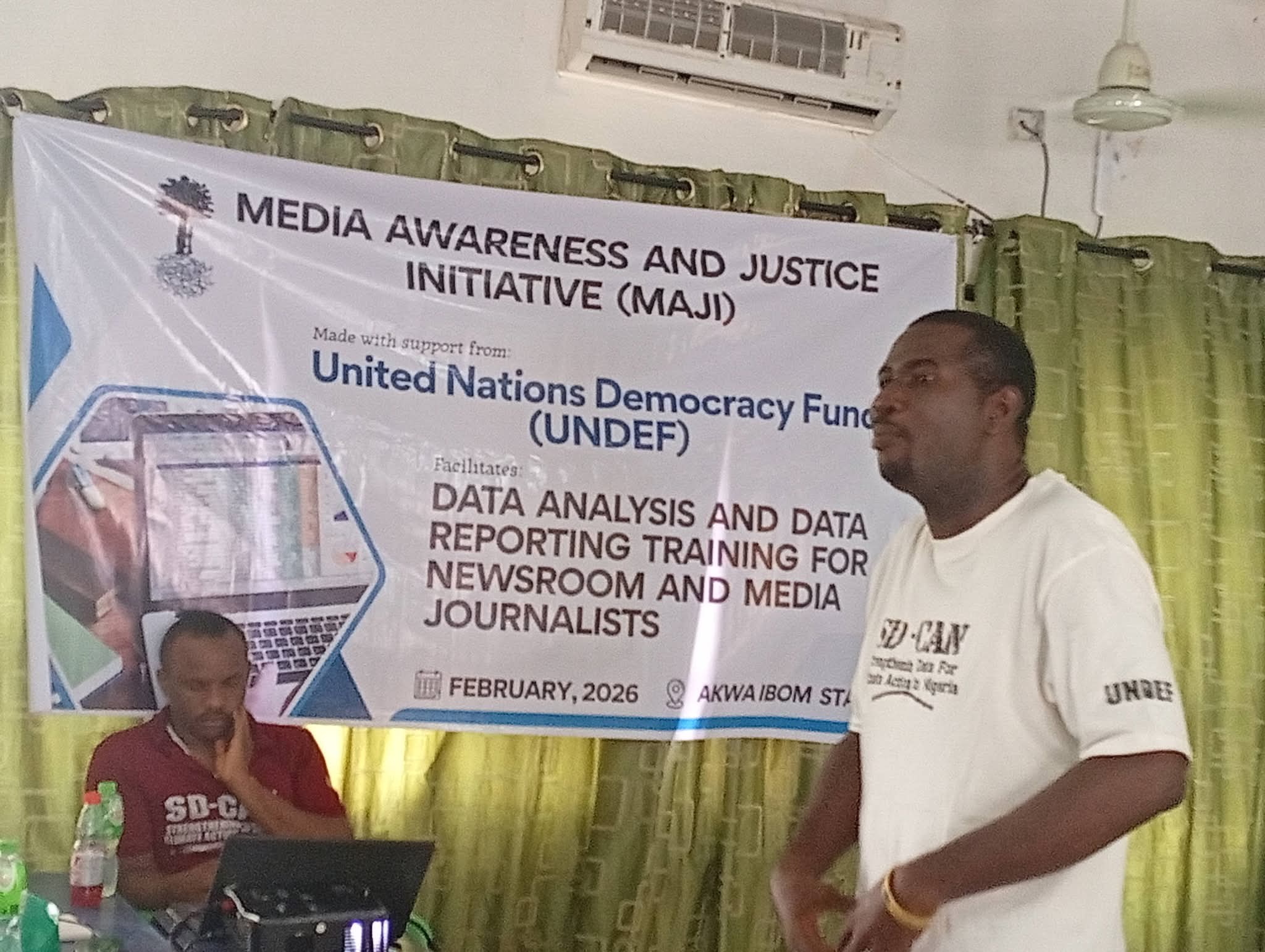
Media Awareness and Justice Initiative (MAJI) has organized a capacity-building training for journalists in Akwa Ibom State on the use of scientific data for environmental reporting.
The one-day capacity-building workshop, themed “Environmental Data Collection for Evidence-Based Journalism,” was facilitated by the Media Awareness and Justice Initiative (MAJI) with support from the United Nations Democracy Fund (UNDEF). The training which was held on Thursday, February 26, at the Nigeria Union of Journalists Secretariat in Uyo, brought together 20 journalists, with a focus on strengthening data-driven reporting and advocacy in the Niger Delta.
Raising the alarm, Environment and Conservation Officer, Ikechukwu Ahaka, said limited access to credible environmental data remains a major challenge undermining effective journalism and public accountability.
He noted that the disconnect between scientific findings and media reporting continues to weaken citizens’ engagement and policy response to environmental issues across the region.
Minister of Marine and Blue Economy commends Rector Maritime Academy of Nigeria, Oron on performance
“Environmental stories should be driven by identified data insights that will promote participatory citizens’ action in a constructive manner,” Ahaka said.
He stressed that equipping journalists with the skills to interpret and utilise scientific data is critical to improving transparency, influencing policy, and amplifying community concerns.
The training, which also covered Bayelsa State and is expected to move to Rivers State, is designed to deepen investigative reporting through the use of participatory technologies and evidence-based storytelling.
Participants were introduced to practical tools for data collection, including sensor-based monitoring, field sampling, low-cost IoT devices, satellite imagery, and mobile data applications.
However, beyond technical training, participants highlighted systemic bottlenecks such as government restrictions, data inaccessibility, and safety risks during field investigations as key policy gaps requiring urgent attention.
Ahaka maintained that addressing these challenges through institutional collaboration, open data systems, and community-based monitoring would significantly enhance environmental reporting outcomes.
In a separate session, facilitator and lecturer, Prince Eze, emphasised that effective advocacy must be anchored on credible, verifiable data.
“Advocacy is a structured process aimed at drawing attention to specific issues and guiding decision-makers toward practical solutions,” he said.
Eze warned that weak data systems often lead to poor policy decisions. He, therefore urged journalists to adopt a more strategic, evidence-based approach in engaging stakeholders and shaping public discourse.
The training ended with a hands-on session on data analysis to equip participants with practical skills in data cleaning, organisation, visualisation, and interpretation for impactful environmental storytelling.
Participants actively engaged in discussions and group exercises, analysing sample data and exploring how to turn raw figures into compelling environmental stories.
Many described the training as timely and impactful, expressing optimism that the knowledge gained would significantly improve the quality of environmental journalism in Akwa Ibom State.